
Reading the banner
The coloured strip at the top of the screen says how current what you are looking at is. Green, amber and red each mean something specific.
2 min read
Every screen that shows you something another machine might have changed carries a banner. It is not decoration and it is not an error — it is the age of what you are reading.
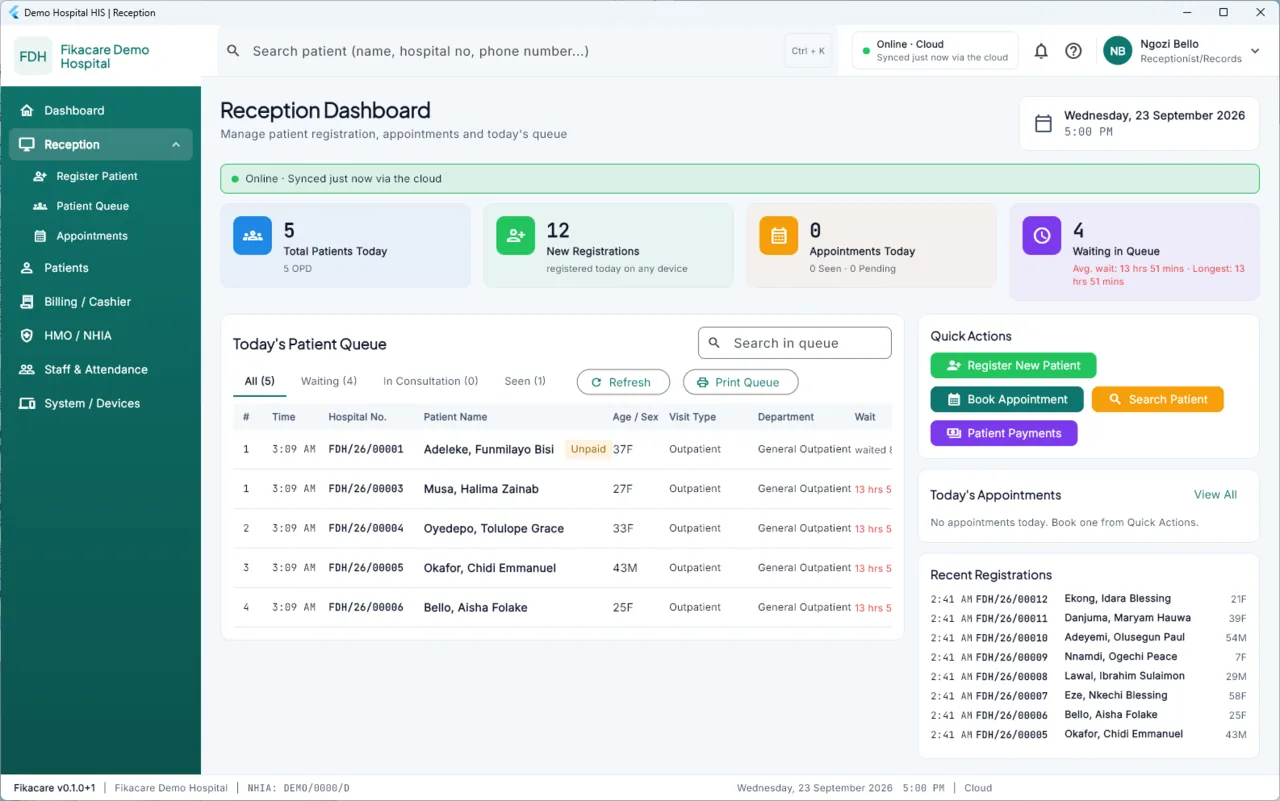
The four states
| Banner | Colour | What it means |
|---|---|---|
| Online | Green | This machine spoke to the rest of the hospital within the last few minutes. What you are reading is current. |
| May be behind | Amber | The last successful catch-up was between five minutes and an hour ago, or the only thing reached was a peer. Probably fine; check before acting on something that matters. |
| Stale | Red | Over an hour since this machine reached anything. Treat cross-machine information as out of date. |
| Alone | Red | This machine has never synced. It knows only what has been done on it. |
| Not all sent | Red | Something else entirely — see Some writes were refused. |
Each also says which rung of the ladder it reached and when: "Synced 3 mins ago via the hub".
What it does not mean
Red does not mean you should stop working. It means what you are reading may be behind, not that the software is broken. Registering a patient, seeing them and taking their money all work exactly the same when the banner is red. What changes is how much you should trust a list that other machines contribute to.
Green does not mean everything is well. Green means this machine synced recently. If its writes are being refused, the banner goes red and says "Not all sent" instead — a machine that syncs punctually while its work is thrown away is the most dangerous state there is, so it is never shown as healthy.
Where it is stricter
On three kinds of screen the banner is escalated one level — what would be amber shows as red — and it cannot be dismissed:
- Allergies.
- Current medications.
- Critical results.
On these, "probably current" is not good enough. If the banner is red on an allergy list, find out what this patient has been given elsewhere before you act on it.